Self-critique
(in progress 🌱)
Context: what it is, why it's useful
Ideally: giving yourself feedback in a way that is honest (doesn’t let you skate over things you find difficult or are self-conscious about, but also isn’t bullying or overly critical), analytical (tries to understand why something is happening the way it is) and constructive (designed to help you improve).
Necessary for growth and deliberate practice. Without the ability to self-critique, practice sessions become confusing, stressful and aimless and progress is likely to stall.
Recommended prior experience/knowledge/skills
- What criticism actually is (❌ negative comments, ✔️specific and actionable advice for improvement)
- What balanced criticism looks/sounds like (what is working, what isn't, ideas for what to try next)
- Ability to regulate discomfort
- Ability to receive feedback without being hurt
- Emotional and/or educational triggers (anything in the learning and feedback process that makes you feel anxious, nervous or vulnerable)
- Your typical learning trajectory, speed and preferences (so you can set realistic expectations for yourself and tailor your self-critique to actually suit you and how you work)
To expand quickly on that last point - this is HUGELY simplified but some people can learn like this:
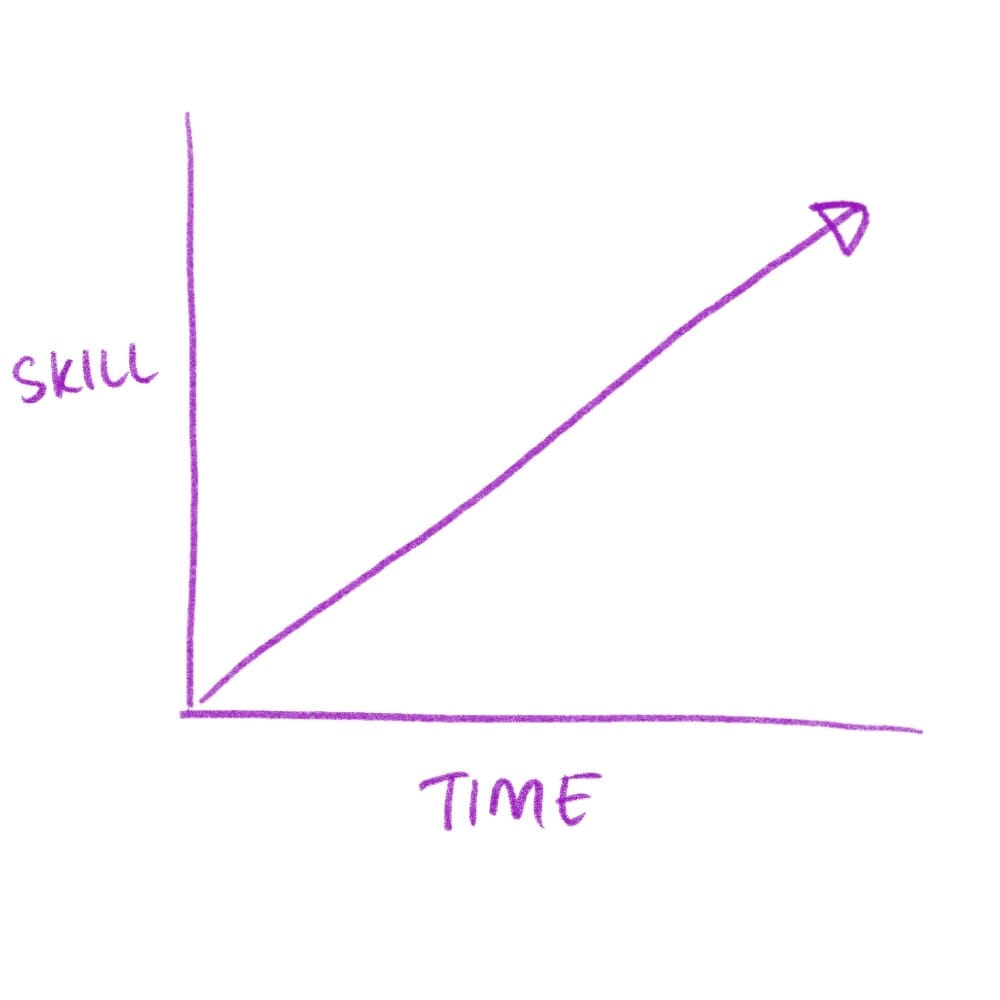
While other people might learn like this:
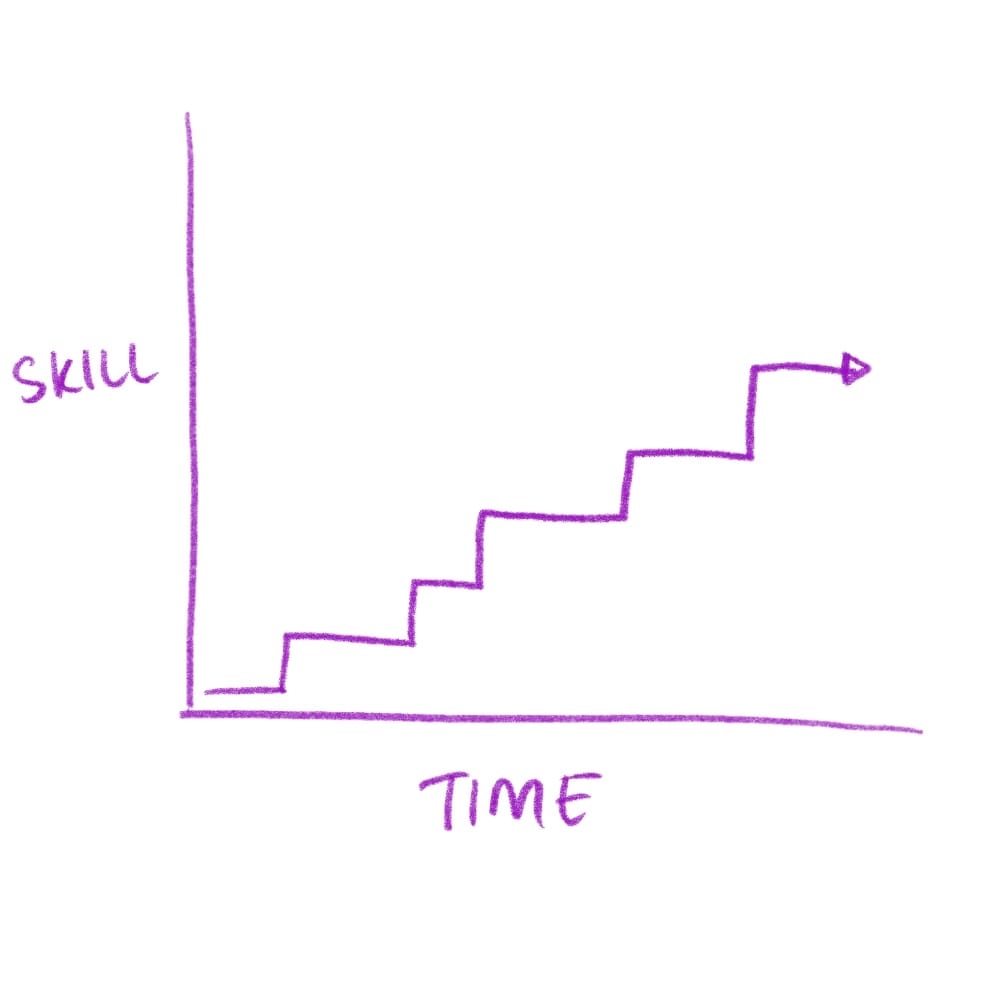
If you're the second graph, you need to remember this when practicing self-critique. Be patient and don't compare yourself to other students (I know this is easier said than done but still).
Difficulty level
I consider this one of the harder skills to practice, especially if you’re an adult who is self-learning (but it’s doable! Please don’t leave).
Colour theory is hard conceptually, line and shape are hard physically, while this is difficult psychologically. You’re going to have to catch ingrained habits and thought patterns (pretty much everyone is going to have at least a couple of these) and train yourself out of them while tolerating the discomfort.
Specific difficulties
While it's normal for learning to be difficult, suffering isn't and shouldn't be an inherent part of the process. You might feel disappointed, discouraged and frustrated at times, but a healthy and sustainable learning practice will have you feeling way more curiosity, joy of discovery, satisfaction, capability, empowerment, creativity and autonomy.
If you find yourself dreading learning sessions, suffering throughout and ruminating on them after, you likely have some kind of Thing to unpick.
The first three points are mental-health related (fourth point could go either way) and should be full topics on their own, so I won’t go too in-depth on them - just enough for you to hopefully recognise if that’s what your brain is doing (identification is the start of recovery, after all) and adjust your self-critique accordingly.
- Anxiety: An outsized fear that you can’t meet some (usually self-imposed) arbitrary criteria. Usually centred around your perceived capabilities, with your brain connecting that to what that says about you as a person.
- Can look like: thinking you are inherently lazy, forgetful, useless, etc if you can't do something, ruminating on what others think of your learning journey, worry over how your shortcomings affect others.
- Self-esteem: The beliefs you have in your ability to Do the Thing (whether at all or compared to others).
- Can look like: negatively comparing yourself to others, taking setbacks as solid proof you can't do things, starting new activities with low confidence, attributing success to things outside of yourself (or having impostor syndrome).
- Perfectionism: A belief that not only can you be producing perfect things, you should be.
- Can look like: focusing on negatives and downplaying or ignoring positives in what you've done, overworking yourself, unwillingness to finish a flawed drawing, difficulties sharing work and asking for feedback, anxiety around starting new things, stress around not already knowing something, wanting others to think you have a certain level of competency and hiding things that fall below that, chronic dissatisfaction in practice sessions and the overall learning journey.
- Unrealistic expectations: A general misunderstanding of what the learning process is like, resulting in expectations you have no chance of meeting (which usually spirals into a self-fulfilling vicious cycle).
- Can look like: "This person online did it this way, so it'll work for me too!", not understanding how big practice tasks should be, getting easily discouraged
- Knowledge: Not having enough technical and perceptual knowledge to actually look at your work and a) know what needs developing and b) how to do it.
- Can look like: knowing you're not happy with what you've made but not knowing why no matter how much you look at it
If you find yourself strugging with any of the first three: people are almost certainly not thinking about your learning journey nearly as much as you think, and if they are, that's not their business anyway (I mean, unless they're your tutor). By learning, you're already doing a deeply cool thing. It's okay to not be doing it well or quickly. Remember how much you're showing up for yourself every time you practice and be patient and supportive when giving yourself feedback (the universal "what would you say to a friend" applies here). Remember negative self-talk is just what you've been taught to say about yourself and repeating it won't make you learn any faster.
For anyone affected by the last two points: learn in chunks that seem smaller than necessary and seek feedback from people more experienced than you. Learn with others when you can (online or in-person, doesn't matter) and build your knowledge up from a wide variety of sources.
How to use self-critique
Here's a basic feedback loop:
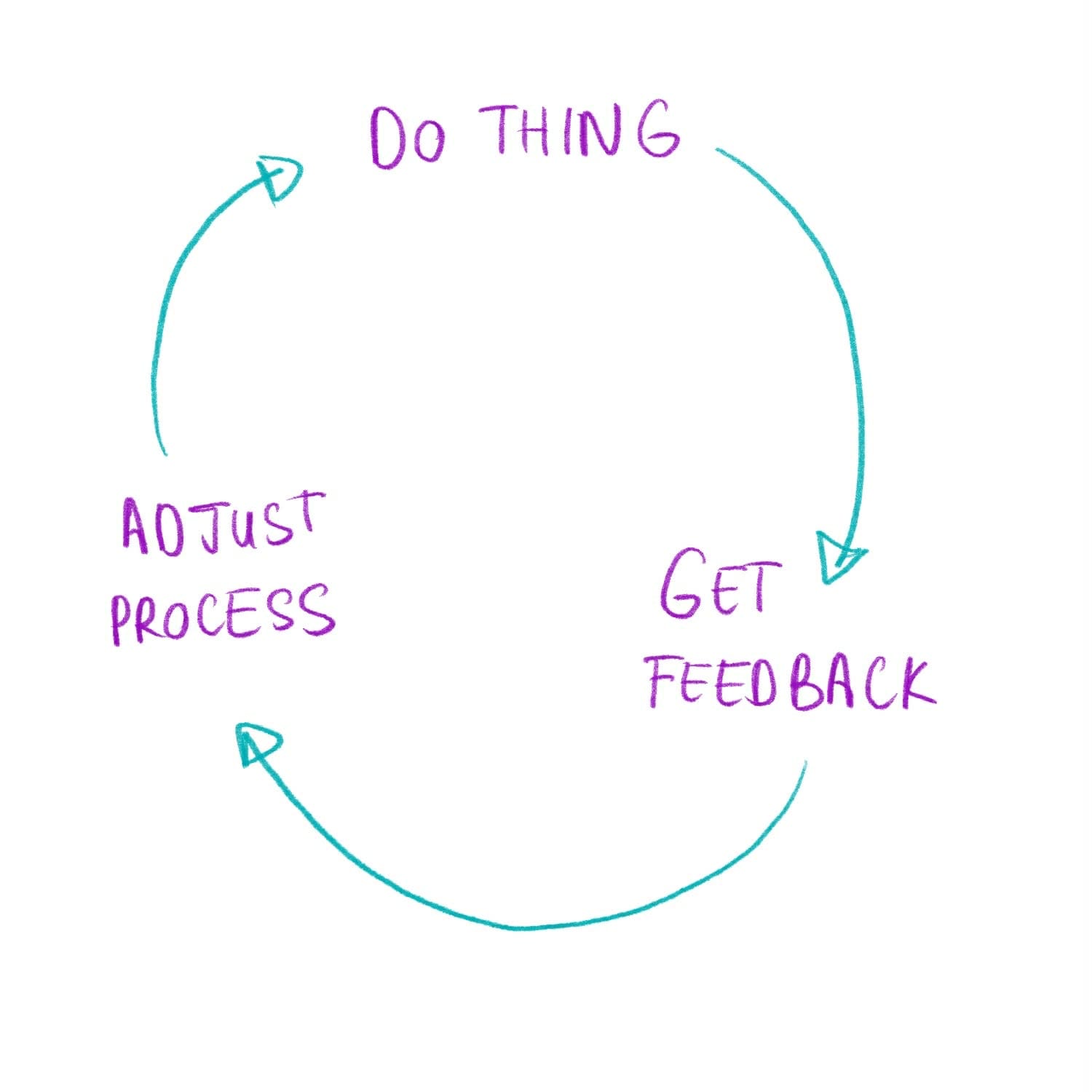
Here's a more detailed feedback loop:
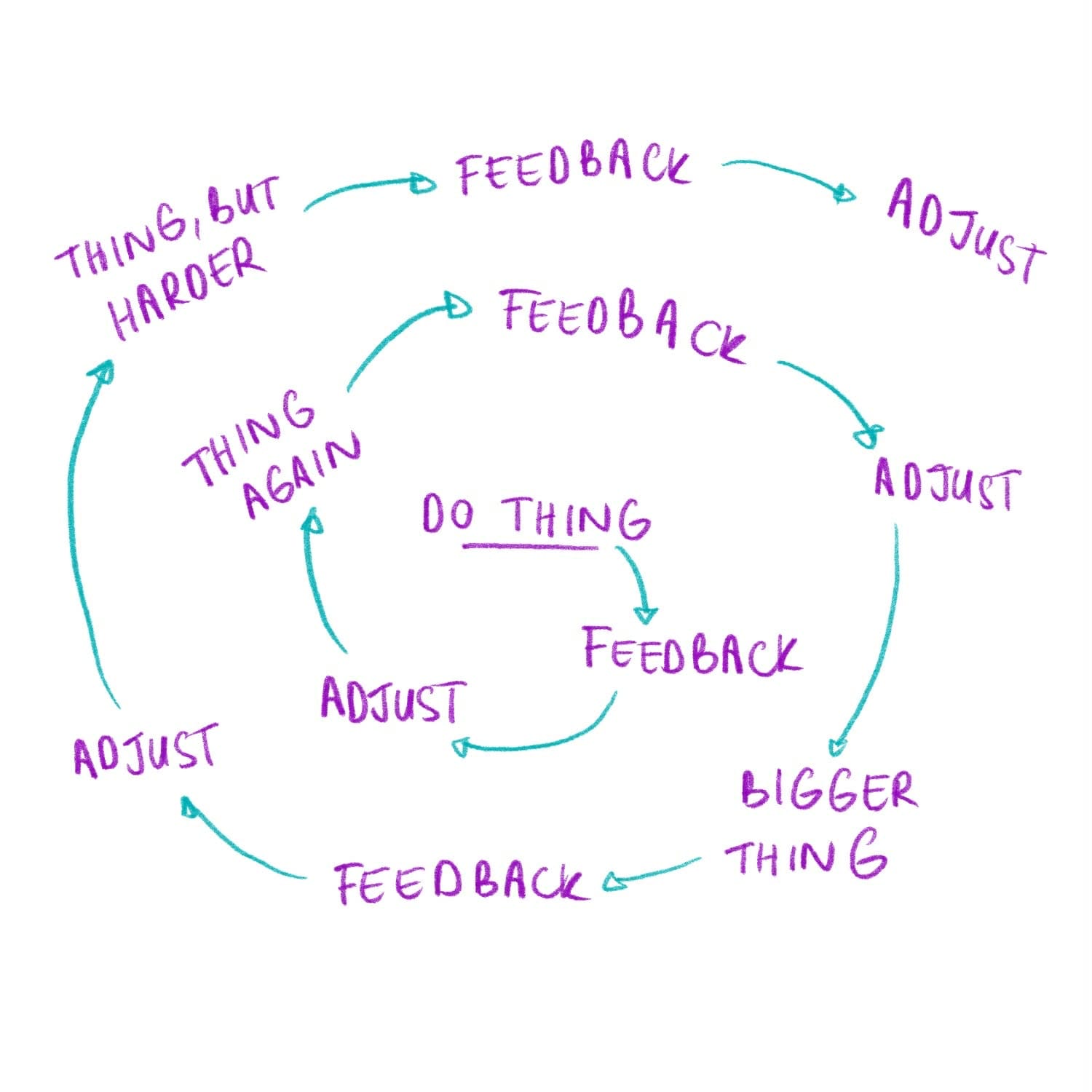
We basically want to be doing this ^ with art things slotted in there. How you do this can look different based on what you're developing, so think of the following as a General Art practice template (I'll be writing more tailored ones for specific skills as I go through them).
Do a Thing
Choose a skill to focus on, set a measurable goal and a task with a small, well-defined scope. If you struggle with anxiety or perfectionism, it can help to either set a timer or have a pre-decided “finishing point”.
Examples:
- Skill: linework → goal: consistent thickness → task: trace a low opacity image using a pressure-sensitive brush. Timer for 30 mins or finishing point: when all lines have been drawn and the thickness consistency is about 80% of the original image
- Skill: shape → goal: consistently draw reasonable 2D shapes → task: draw round Pokemon (Pokemon are honestly so good for practising basic shapes). Timer for 45 mins or finishing point: draw 2 recognisable Pokemon
- Skill: angle → goal: draw faces from different views along the x-axis → task: draw faces with a 3/4 angle facing both left and right. Timer for 45 mins or finishing point: left and right-facing versions of one face that are recognisably the same character
The examples I’ve given above are quite detailed and deliberate, but that’s because I have a lot of practice in setting these sorts of goals and tasks. If you’re unsure on how to set goals or how to choose appropriate tasks (which is completely normal and something you’ll get better at), I’ve included downloadable checklists at the end to help you out.
Note that if you’re further along in your art journey, it’s fine to practice more than one skill per task/have a larger scope.
Make Notes
This works best if you have some kind of journal to collate your drawings and annotate them. You want to be building a progress document where you can see changes and patterns over time.Things to note down:
- the date (and if you struggle with consistency and motivation, the time of day)
- how difficult you found it and where the difficulties seemed to be
- what worked (AT LEAST one thing, for anyone struggling with self-esteem or perfectionism) and what didn’t. Be specific with this - “bad linework” is unhelpful, while “shaky lines” or “line thickness not consistent” is helpful. If getting feedback is difficult for you, practice thinking of this step as just giving yourself more information. Nothing is good or bad, it’s just info that will help you make decisions on what to do next.
Do another Thing
Taking into account the previous two points, decide if you should:
- Repeat: do the same task again, perhaps with some tweaks to make it interesting (but essentially the same thing and same difficulty level). Recommended if you felt you could only just complete the task at the current difficulty level.
- Continue: do a harder version of the task. This could be trying a more detailed version, a larger version, a mirrored version, adding creative freedom, etc. You want the same thing but hard enough that it feels new. Recommended if you found completing the task easy or routine, and didn’t feel you learned anything doing it.
- Adjust: staying with the same skill, but changing the goal or task. Recommended if you’ve done the same practice exercise a few times, but things aren’t sticking and you’re not sure why. Generally, going back to the last thing you found easy/doable and continuing from there tends to help and can show you things you missed the first time around.
- Pivot: changing the skill focus. This is going to happen a few times as skills are layered and understanding one will influence how you understand others. Recommended when:
- your current work sparks a realisation or idea about something you’ve covered before
- you’re finishing up with one skill pathway and are ready to move onto the next. Before starting a new one, you should have a few creative sessions where you combine what you’ve just learned with past learns (like picking up a new skill or key in a metroidvania and re-visiting old areas to see what you can unlock this time around).
- Take a break: if you’ve been working on technical skills, take a creative break. If you’re already on a creative break, stop art practice for a few days. Consistency is important, but pushing yourself and learning new things every day is a lot, especially if you’re new. A few days is generally enough for you to feel refreshed while not being so long that it ruins momentum. Recommended for when you feel overwhelmed, tired, or like everything is taking a lot more effort and energy than it usually would.
Repeat
Once you’ve finished making/doing the new Thing, make notes on it, choose your next action, do the next Thing. With time, as you widen the scope of your goals and gain fluency in your tasks, your progress should look like that detailed feedback loop.
Helpful things
Things that can streamline this whole deal:
- Someone external who can point things out to you - friend, learning buddy, therapist, mentor, tutor, etc. Good for recognising any unhelpful thought patterns, telling you when you’re too far down a rabbit hole, or pointing out technical art things you aren’t yet able to see.
- Practicing critique - go to an art forum or learning group where there’s an established culture of sharing feedback. See how others give and receive critique, practice giving and receiving critique yourself.
- Journal - make notes on how you’re feeling throughout practice sessions and adjust how intense your sessions are as you go
- Don’t throw out old work. As you learn, you’ll look at old work differently and have new realisations about it. It’s also so common for people to only realise how much they’ve grown when they look at past or early work, and it’s very very likely you’ll need this encouragement at some point. I don’t care if it’s embarrassing, don’t throw it out!
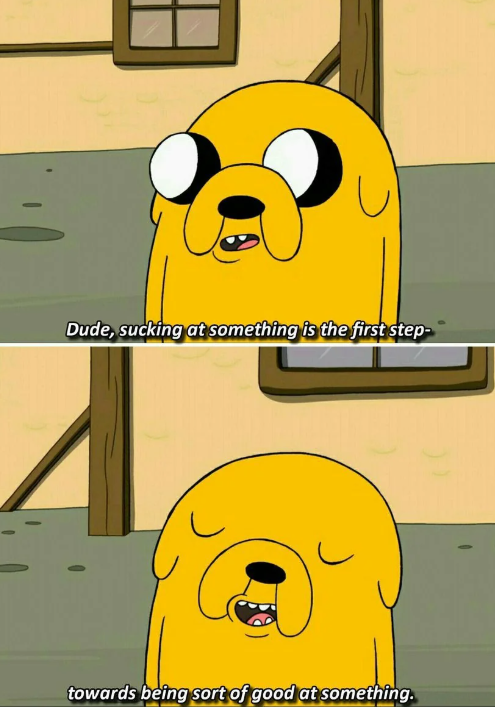
- Always remember:
Resources
🚧 downloadable sheets are in progress 👷🏽♀️🔨
Feedback
Did I miss anything, make any mistakes? Do you have art questions or topics you'd like covered? Let me know in the comments or using this form.
Feetnotes
- All diagrams and downloadables made by me
- Screenshot ("Sometimes I sit in a chair late at night..") from the deeply excellent “World of Tomorrow” by Don Hertzfeldt.
- Screenshot of Jake the Dog (Adventure Time).