Developing an Art Style
Context
Generally when you’re learning art, there are two pathways you could take: learning realism or developing a personal style. Realism is basically representing the world as it is, as closely as you can (so a high focus on the external world around you), while personal style is more bringing others into how you see things (high internal focus - how you perceive and interpret). Realism is generally valued for technical difficulty, awe and beauty, while personal style is loved for expression, storytelling and connection.
To potentially be a bit romantic and grand about it, you could say realism is a way to remember the world, while personal style is a way to impact it.
Difficulty level & specific pinch points
I would say learning realism is mechanically difficult and time-consuming, but otherwise straightforward (a tame problem), while developing a style could be very technically simple (think Peanuts) but deeply confusing (very much a wicked problem)
If you have alexithymia, this journey will be trickier (but still possible), since making a personal style involves checking in with your feelings and opinions a lot. I’ll write more on how to work with alexithymia in the “Actually Doing It” section near the end. For now, these are the sorts of things you’ll be asking yourself and will contribute to the overall difficulty level:
- which styles do you like looking at?
- which skills do you enjoy working on?
- what are you’re good at? (that’s right, you have to admit you’re good at stuff)
- how much patience do you have?
- how much of a perfectionist are you?
- how do you see the world?
- how would you like others to see the world when they look at your art?
Recommended prior experience/knowledge/skills
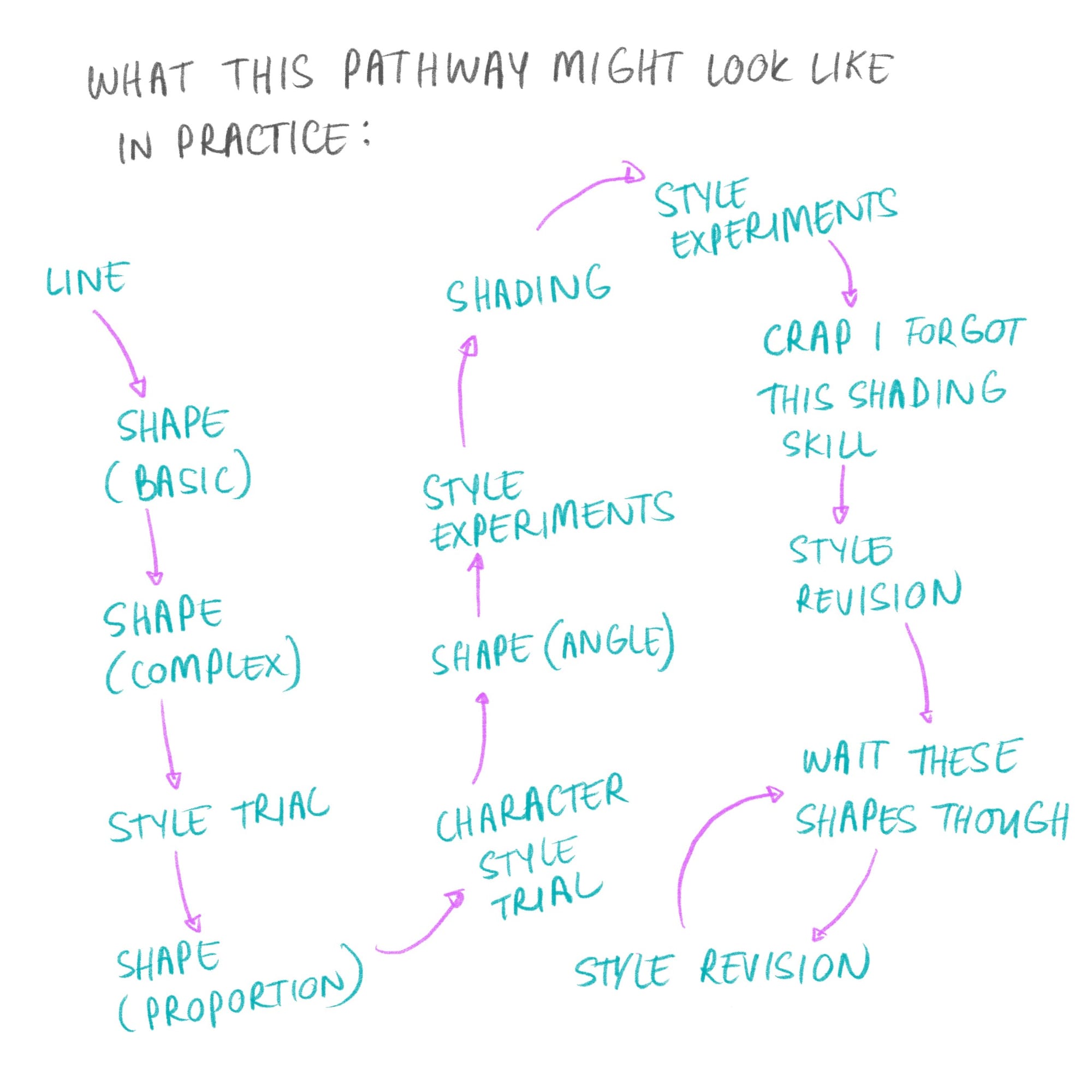
Okay, so. Honestly, it does help to have at least some understanding of realism - knowing basic representation and visual language "grammar" means you'll have a starting point for expressing yourself in ways you prefer. This isn’t to say you need to do an entire realism course before starting your style journey - it can be an iterative thing where you learn a bit of realism → experiment with those mechanics → learn a bit more realism → rinse and repeat.
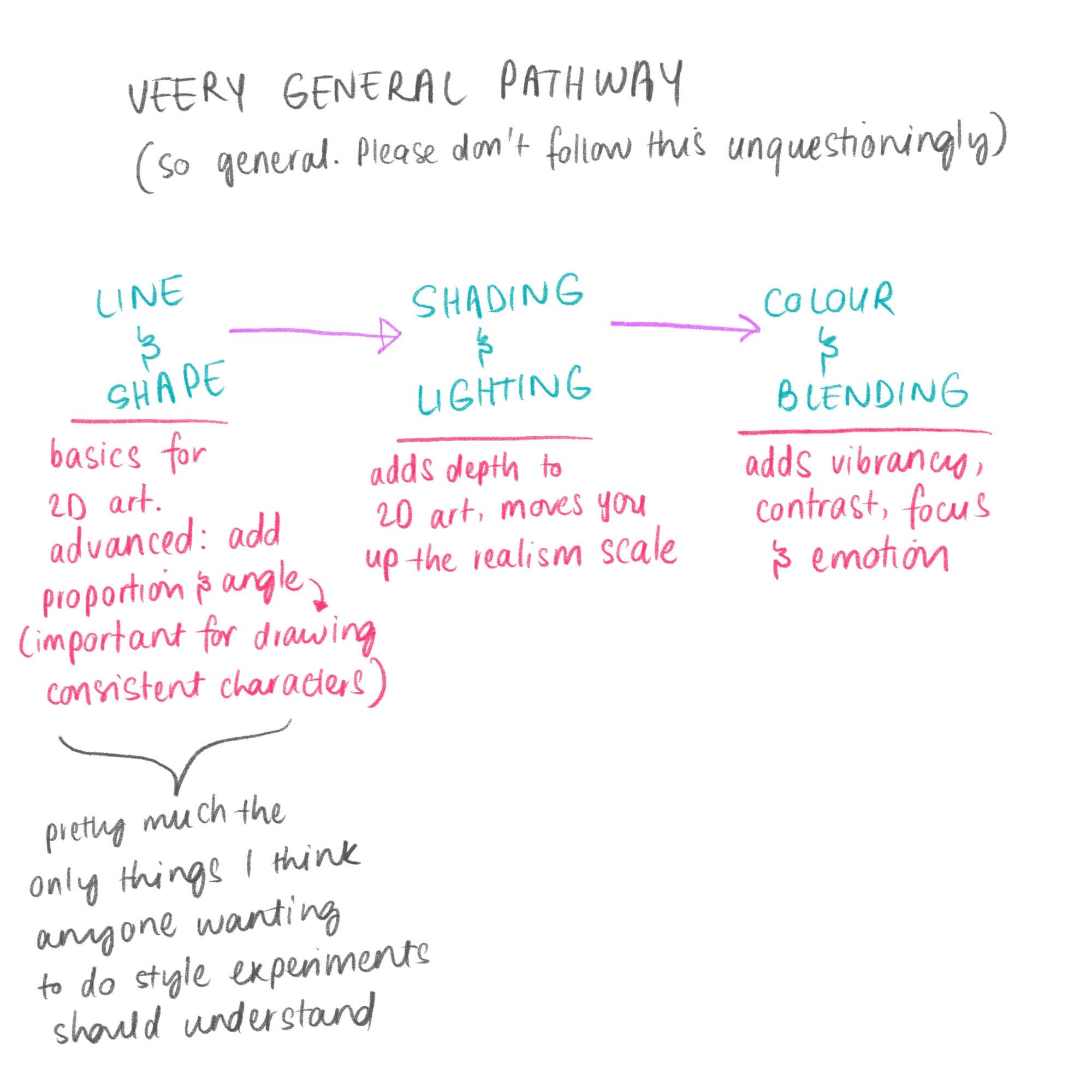
I’d say the absolute bare minimum skills to have experience in are line and shape - style development involves a lot of experimentation, so being able to quickly and reliably draw the shapes you need for those experiments will make the whole undertaking way easier.
From there, if the style you’re aiming for involves depth, then learn shading and lighting.
If it involves colour, you will have to learn colour theory (sorry) and blending.
In case lists are confusing, here's a visual:
Possible biases/knowledge holes
Of course, this isn’t a complete list - this is just what I’ve seen in students I’ve had. They do seem to be common across learners, so they're worth at least mentioning:
You can only like/dislike what you’re exposed to - search out new forms of art
This one can be a bit dangerous if you’re an optimiser, but it’s worth taking purposeful trips outside your media bubbles. You can think of it almost as a media diet of sorts - give yourself as varied a visual diet as possible, think about why things do or don’t work, consider your opinions and gut reactions when looking at new things. A really important one is to seek out art that isn’t typically aesthetic - ugliness is so commonly sanitised from media and it really shouldn’t be.
“I can’t learn by looking at [artist], that’s copying”
Copying is an inherent part of learning - we mimic others when learning to ride a bike, to cook, speak other languages, etc. Expecting yourself to learn art without copying or reference is basically expecting yourself to create a new drawing system/style with zero knowledge. We don’t ask this of other subjects - imagine if we expected ourselves to create a new counting system while learning math, or didn’t allow ourselves to learn existing choreography when learning to dance.
Existing knowledge and systems should be a public resource. Use them, learn from them, build on them for whoever comes after you. Be open about your sources and you’ll be fine. You can pay the knowledge back in the future when new learners use your work as reference and inspiration.
“Cartoons are not Real Art, so I should avoid those styles to be a Real Artist”
Incorrect. Next!
“I should have one special signature style to be a Real Artist”
You can have as many styles as you want and you can go between them whenever you like. Plenty of artists use styles as tools for certain jobs (for example Bill Watterson), and it’s also fine (and normal) for styles to change over time.
Ways of thinking about style
At the moment, the space of “realism” and “personal style” likely sounds very vague and hard to imagine a path through. Having a way to mentally organise the thousands of styles that exist will hopefully help you study and understand them. First up:
Abstract → hyperrealism spectrum
Realism is a spectrum, which looks like this:
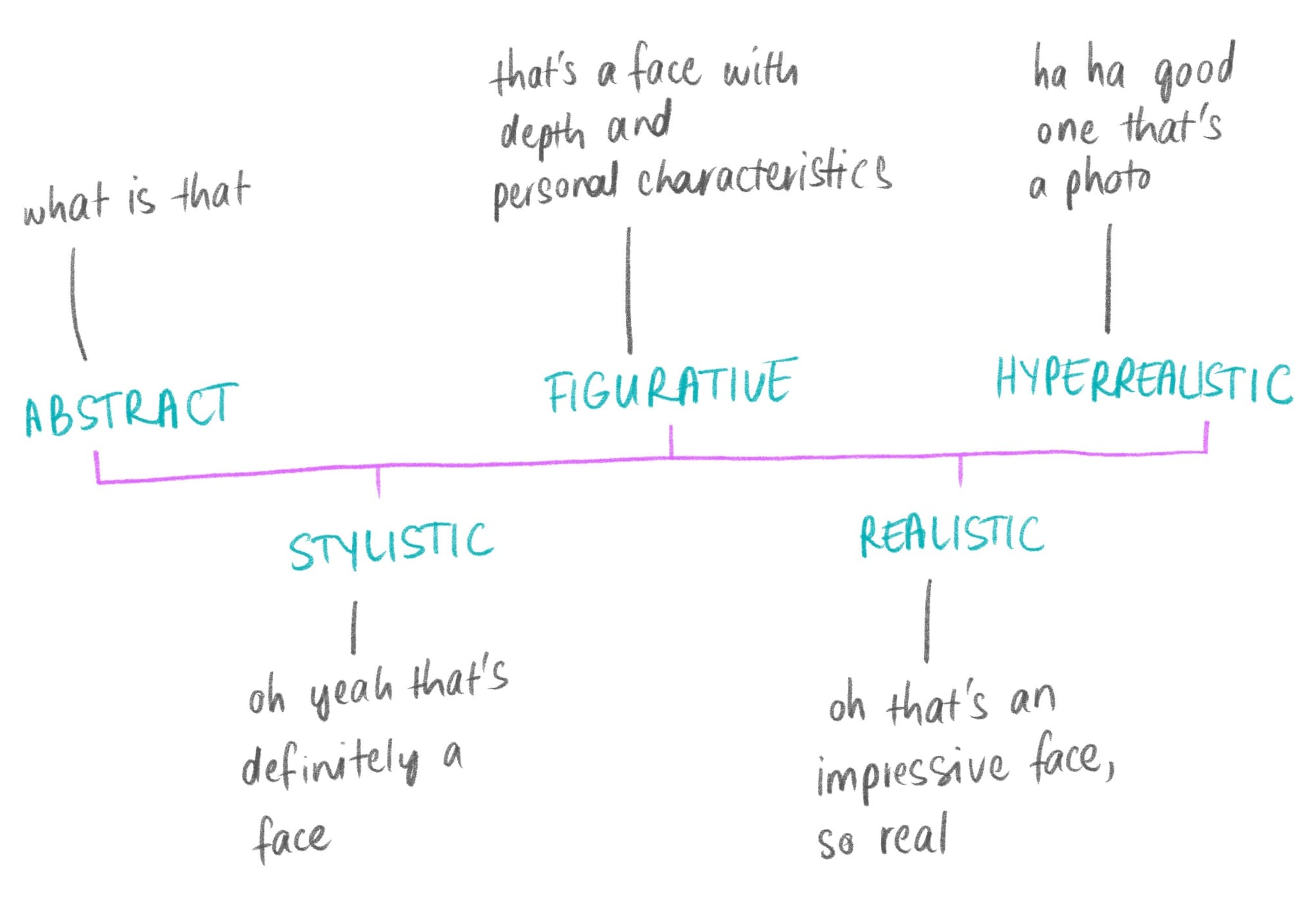
Personal art styles usually happen around the stylistic and figurative areas. To help you gauge what the categories along the spectrum look like, here’s where I’d place these popular art styles (I’d say their category placement is pretty objective, but how far along the spectrum they are is definitely arguable and subjective):
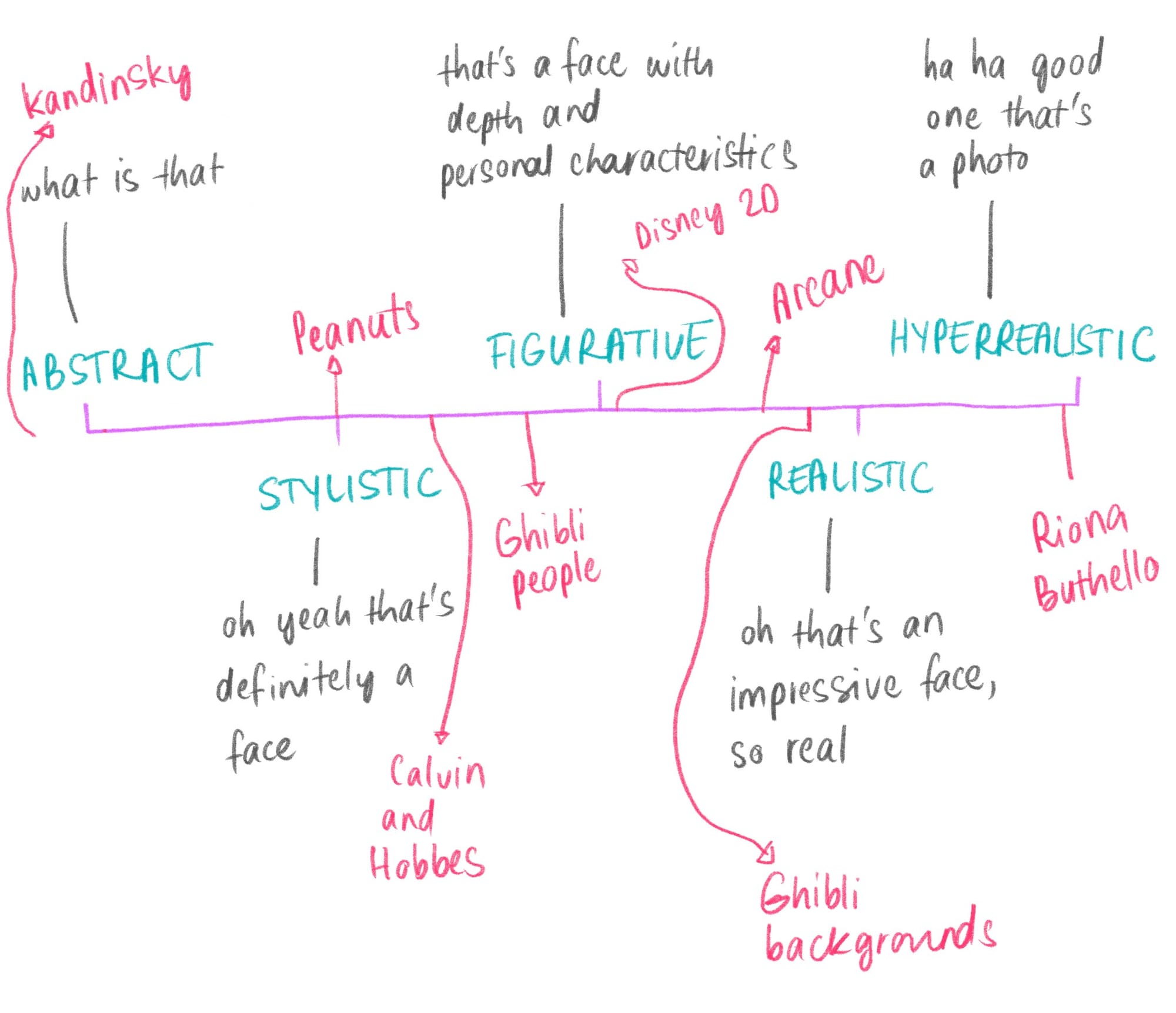
A common pathway is for people to learn enough to be able to play around in the figurative area before focusing on personal style development.
Company/Studio/Franchise
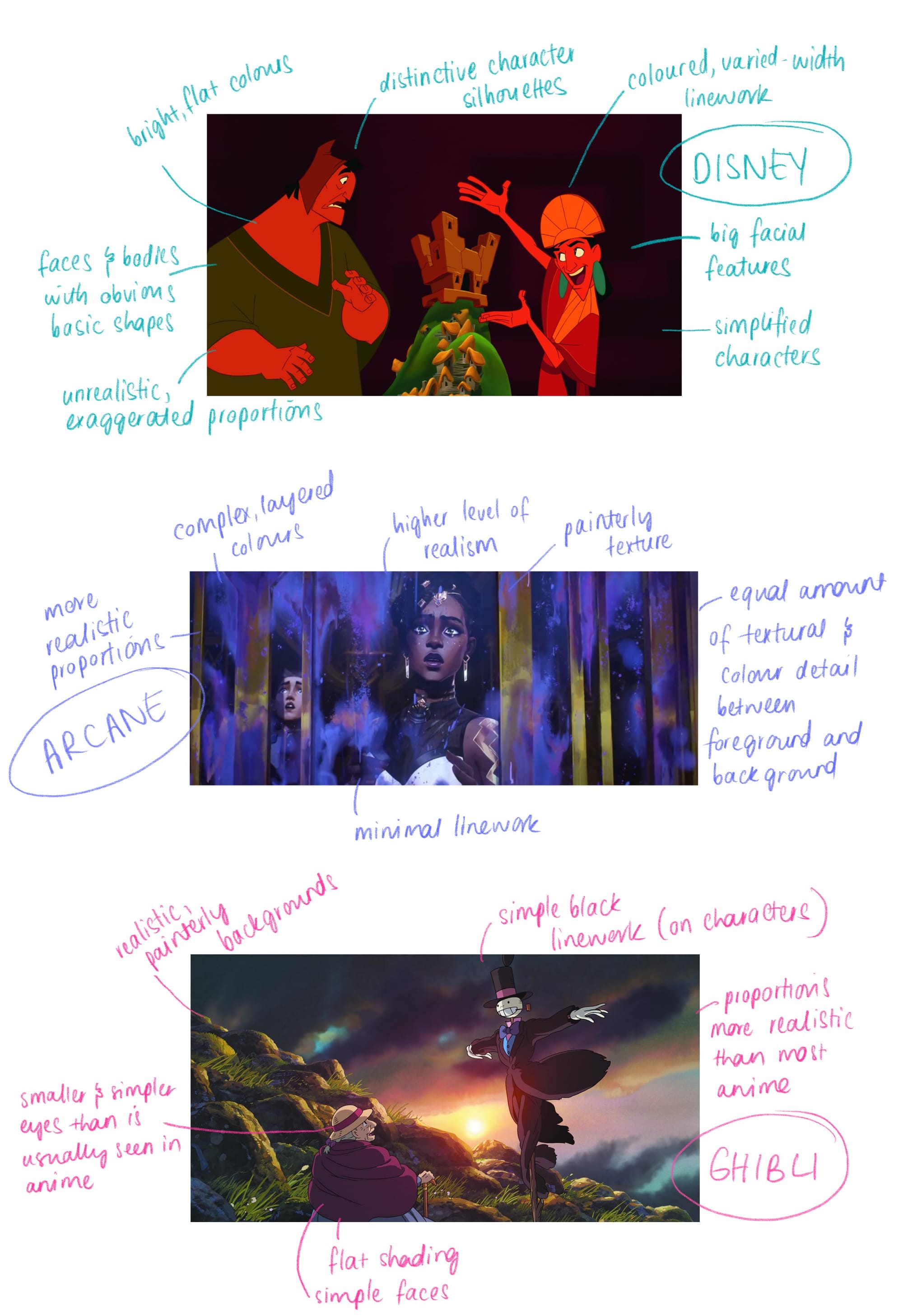
When companies/shows get popular enough, their signature art style is referred to by their name as a shorthand (think “Disney style” art or “Ghibli style” characters). Thinking about popular studio styles and what distinguishes them can help you consider what you’d like your style to become. For example:
Actually doing it
As promised, a followable pathway for Doing The Thing. Disclaimer: This isn’t the only way to do it, and I couldn’t say if it’s objectively the best way for you specifically, since I don’t know you. But after teaching this for a while to different people, these activities in this general order (you’ll likely loop between steps) do seem to work well.
Learn basic fundamentals
Get decent at linework and shape before experimenting too hard. This doesn’t just make style experiments easier, it actually makes them viable. If you can’t draw lines and shapes in ways you intend AND you’re experimenting with new things, you won’t know what to make of your results. Does the thing look unfinished/bad/weird because of the shaky lines, the shapes not lining up, or because of the colours you’re trying? The inverse (not knowing why something is working) is deeply unhelpful too - you don’t want to turn random things into habits because you think they're what's working.
To do this, you can have a look at the Shape, Line and Self-Critique subjects.
Find things you like
Potentially super obvious, but to make an art style you have to know what you actually like. Don’t just look at one type of media, either - look at game art, movie stills, theatre costumes, animations, sculptures, anything you can think of. Save what you like, take note of who made it and what they used. See if patterns emerge over time across the things you save - does everything tend to have bold colours? Strong character focus? Unusual camera angles? These will be useful starting points for your style experiments.
If you’re alexithymic and don’t know how to do this step, try these:
- Instead of asking “did I enjoy that?” ask:
- Do I want to do that again?
- Do I feel uncomfortable or painful physical sensations drawing that? Or was it neutral or even pleasurable?
- Show people around you what you’ve drawn. Do their reactions to your work make you think or feel anything (whether emotional or physical)?
- Skip to the “trying things you don’t like” step
- Try using a visual aid, like a feelings list/wheel or emotion matrix
- If none of these help, you may have to develop your interoception a bit more - at least enough so we can get these clues. More info here and here.
- If all of that doesn’t help, you may just have to do it for a longer time (this stuff isn't going to be immediate). Otherwise, I’m afraid I don’t have the knowledge to help you (yet, anyway - I’ll keep learning).
Try things you like
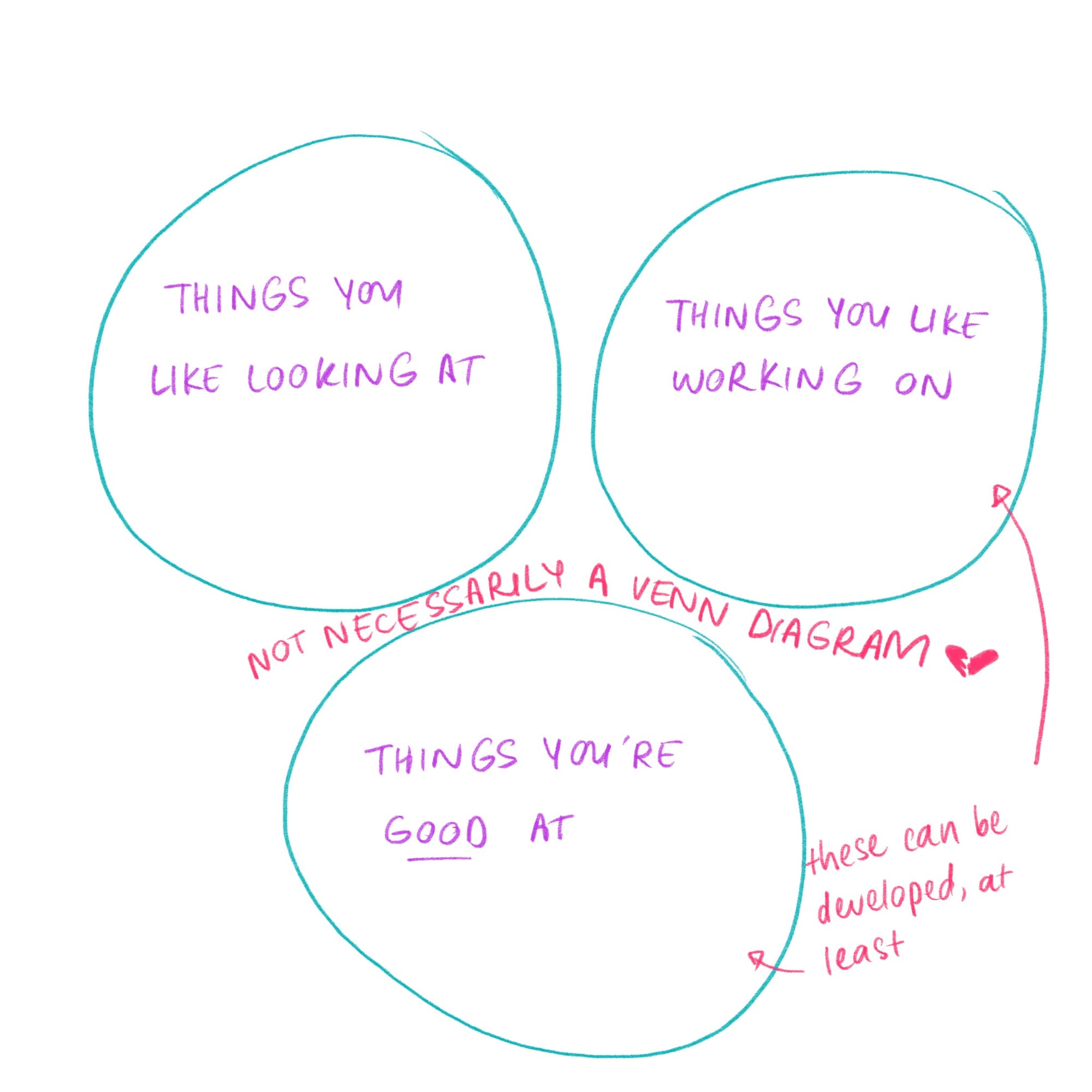
A very sad fact is that sometimes we don’t actually like to draw the things we like looking at (I know, I’m sorry). This step is to filter out anything that isn’t in the centre of this venn diagram:
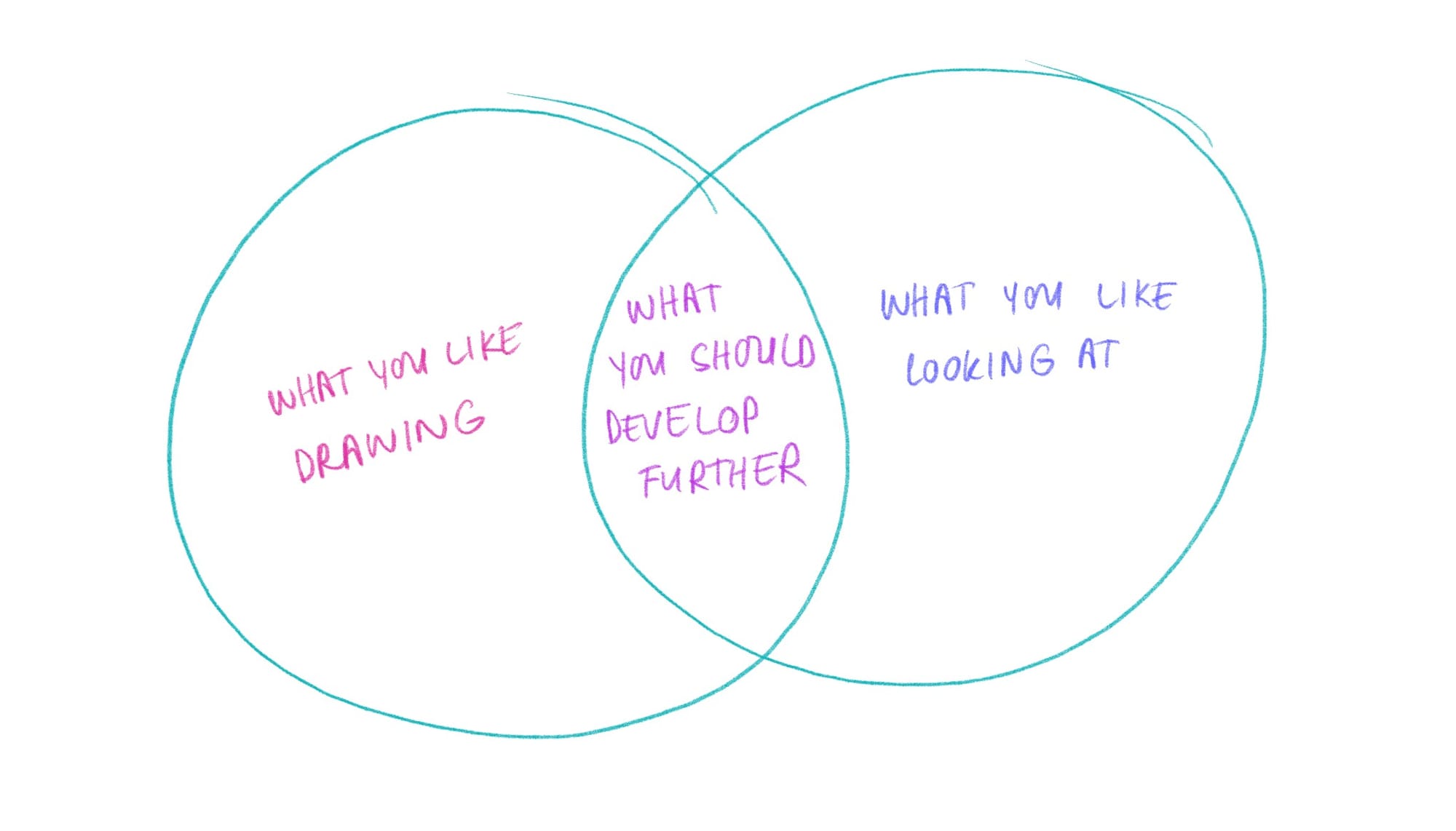
Go through the things you've collected from the previous step and start with whatever you think looks easiest. Do this a few times before moving on to the next style you'd like to try.
Try things you don’t like
Another sad/weird fact is sometimes we like drawing things we don’t like looking at (sorry again). This step is to find if you have those things so you can figure out how to turn them into things you do like the look of. It’s also just useful to know what it feels like to really Not Want to Draw The Thing - for our alexithymic pals, this can be easier than knowing directly what you like.
Experiment by practicing making creative decisions
Hopefully by now you’re pretty good at shapes and lines and have a fair idea of what you like drawing. Now it’s time to practice creative decision-making, which looks like applying either curiosity ("what would it look like if I did [x]?") or opinions ("this picture would be perfect if only it had [x] or didn’t have [y], so I’m going to change those") to illustrations you like.
As your practice progresses, see if there are patterns in the sorts of decisions you’re making. Are you always making changes in the same way? If so, how else could you change the drawing to express your preferences?
- For example, let’s say I enjoy characters with expressive eyes that draw the viewer’s focus, so I enlarge the eyes in every study I do. Instead of this, I could try:
- Making the face size or other facial features smaller
- Adding detail to the eyes so they’re more attention-grabbing
- Changing the shape of the eye rather than the size
- Moving the eyes further apart
- etc.
Practice and test out one new thing at a time. This will make it easier to set goals and track progress througout your exploration. When you reach a point of satisfaction in one area of your style, move on to another aspect and repeat the process.
Checking progress
Since style is a subjective thing, progress can’t be measured in a clear-cut way. Instead, look at previous drawings and see how satisfied you feel with them compared to your satisfaction level with your current drawings.
Keep in mind that progress might not always LOOK like progress - perhaps the technical difficulty of what you’re working on has gone down, but that’s fine if your happiness is going up.
Recommended media/artists/resources
Usually I'd list things I think you should look at here, but since this is about personal style I don't want to influence you too much. Perhaps this is a thing you can instead talk about in the comments, if you would like to!
Feedback
Did I miss anything, make any mistakes? Do you have art questions or topics you'd like covered? Let me know in the comments or using this form.
Feetnotes
- All diagrams drawn by me
- Disney, Arcane and Ghibli screenshots from imdb.